Chamonix's Mural of Mountain Guides
Taking a walk through Chamonix town centre, just across the road from Lou Lou Apartment. you will surely notice an impressive mural on the main street, Rue du Docteur Paccard. Looking up towards their shared fascination, Mont Blanc; twenty of the most celebrated guides and mountaineers are represented in extraordinary precision in the best of Chamonix’s Murals.
The Mountain Guides fresco in Chamonix
Walking through Chamonix town centre, just across from Lou Lou Apartment, you will notice an impressive mural on Rue du Docteur Paccard. It is hard to miss.
Looking up, the artwork draws your attention to Mont Blanc and the valley’s mountaineering heritage. The mural brings together twenty of the most celebrated guides and climbers, all painted in remarkable detail. It is one of the most striking frescoes in Chamonix.
The story behind the mural
The fresco was created by award-winning artist Patrick Commecy, founder and artistic director of A.Fresco. Since 2002, his team has produced more than 150 murals across France, Italy and Switzerland.
The Mountain Guides fresco was funded by the town and inaugurated in July 2010. For the first time, some of Chamonix’s most legendary figures are brought together in a single image.
Who is featured?
The fresco brings together members of the Compagnie des Guides de Chamonix in a single scene.
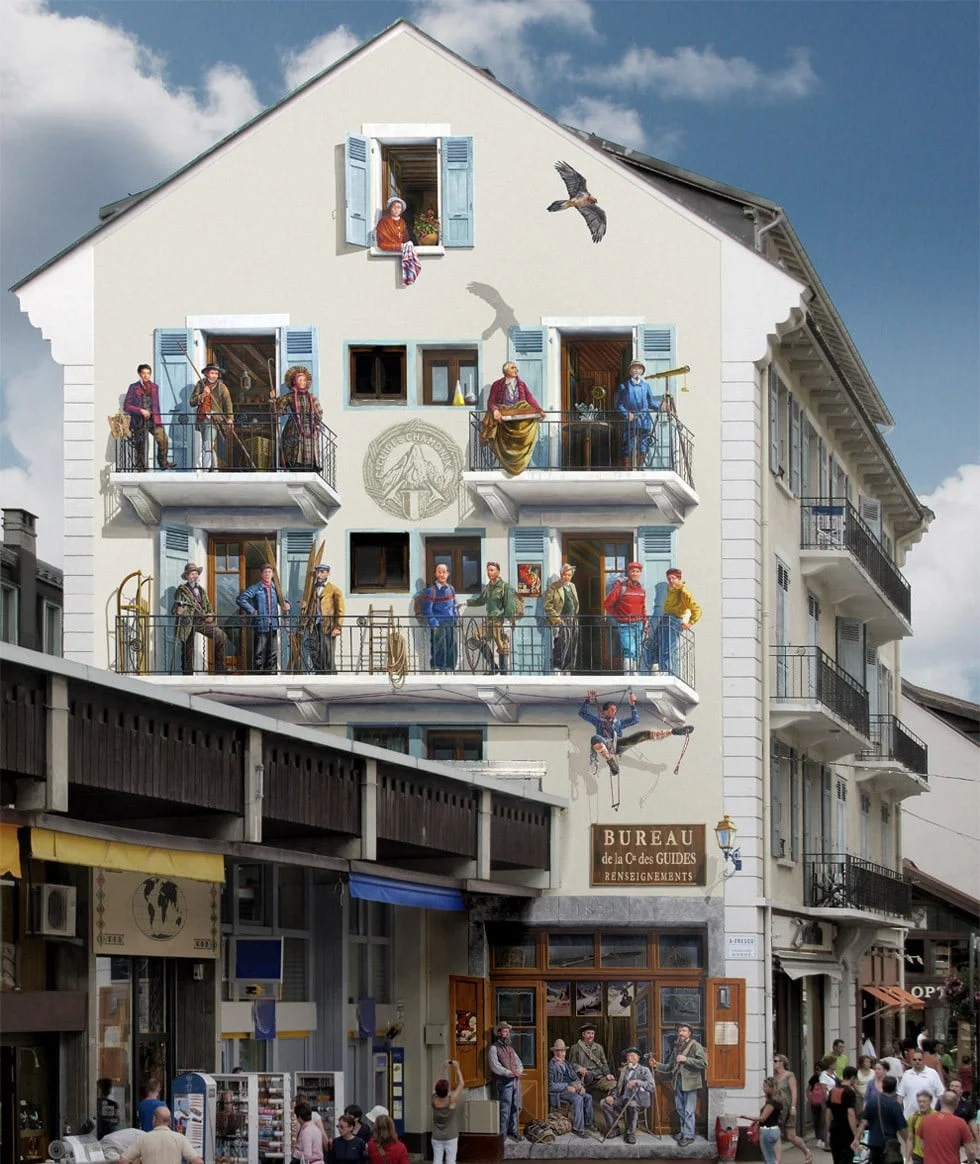
It spans different periods of mountaineering history. On the top left balcony, you can see Michel-Gabriel Paccard and Jacques Balmat, who made the first ascent of Mont Blanc in 1786.
Elsewhere in the mural, Gaston Rebuffat is shown suspended in his harness, reflecting his work as both a mountaineer and filmmaker. Marie Paradis also appears in one of the upper windows, recognised as the first woman to summit Mont Blanc at the age of 29.
The figures are arranged across the façade, each placed within the architectural details of the building, creating a snapshot of Chamonix’s mountaineering history.
Chamonix’s Historic Guides
Ground floor (guides office)
On the ground floor, the fresco highlights several notable mountain guides from Chamonix.
From left to right, Edouard Cupelin (1804–1906) is known as the “Captain of Mont Blanc”. He completed around 80 ascents of the summit. He also achieved several firsts in the Alps, including the first winter ascent of the Aiguille du Midi in 1883.
Next is François Devouassoud (1832–1905), a teacher and mountaineer. He played a key role in the spread of mountaineering beyond the Alps. In 1868, he made the first ascents of Kazbek and the east summit of Elbrus in the Caucasus, along with many other climbs worldwide.
Joseph Ravanel (1869–1931), known as “the Red”, was often called the “guide of kings and king of guides”. He worked with notable figures including King Albert I of Belgium. He also appears, under the name Joseph Ravanat, in the novel Premier de cordée by Roger Frison-Roche.
Michel Payot (1840–1922), both a guide and a farrier, completed several important first ascents. In 1877, he climbed the southern side of Mont Blanc via the Peuterey ridge, a route not repeated for many years.
Finally, Michel Croz (1830–1865) was one of the leading guides of his time. He made first ascents of major Alpine peaks, including the Barre des Écrins and the Aiguille d’Argentière. He is also known for his partnership with Edward Whymper and for his death during the first ascent of the Matterhorn.
Dangling figure
Gaston Rebuffat (1921–1985) was a mountaineer, writer and filmmaker. He was part of the first expedition to summit Annapurna I in 1950.
He is also known for being the first climber to complete all six of the great north faces of the Alps. Alongside his climbing career, he wrote ten books and produced three films about his experiences.
1st floor balcony
The first floor balcony is split into two groups of guides and mountaineers.
Left side (from left)
Jean-Esteril Charlet Straton (1840–1925) began as a shepherd before becoming a guide. He completed many first ascents with his partner, later his wife Isabelle. These include Pointe Isabelle in 1875 and the first winter ascent of Mont Blanc in 1876. He also made the first ascent of the Petit Dru in 1879.
Alfred Couttet (1889–1974) was the first French ski champion in 1909 and captain of the French ski team at the 1924 Winter Olympics. He achieved around 40 first ascents across several mountain ranges. He also introduced modern climbing equipment to the Dolomites and helped develop climbing in Chamonix, including at Les Gaillands.
Michel Payot (1869–1908) was a doctor who pioneered the use of skis in the valley. He used them to reach patients in remote villages. He also completed early ski routes, including the Chamonix to Zermatt crossing in 1903, and organised the first international ski competition in Chamonix in 1908.
Right side (from left)
Louis Lachenal (1921–1955) was one of the first climbers to reach a summit over 8,000 metres. In 1950, he summited Annapurna I with Maurice Herzog. He later died in a skiing accident in the Vallée Blanche. Pointe Lachenal is named after him.
Lionel Terray (1921–1965) was a leading mountaineer with first ascents in the Alps and beyond. He was part of the 1950 Annapurna expedition and co-authored the well-known book The Conquerors of the Useless. He often climbed with Louis Lachenal and set new speed records.
Roger Frison-Roche (1906–1999) was a guide, explorer and writer. He founded the climbing school at Les Gaillands and wrote Premier de cordée. He also worked on the 1924 Winter Olympics in Chamonix and later became the first non-Chamoniard admitted to the Compagnie des Guides.
René Claret-Tournier (1917–2013) completed over 500 ascents of Mont Blanc. He followed in the footsteps of his ancestor Michel-Gabriel Paccard. After serving in World War II, he returned to guiding and worked with international clients.
Armand Charlet (1900–1975) specialised in difficult climbs. He summited the Aiguille Verte more than 100 times and referred to it as “his” mountain.
2nd floor balconies
Left side
Michel-Gabriel Paccard (1757–1827), a doctor, and Jacques Balmat (1762–1834), a crystal hunter, made the first ascent of Mont Blanc on 8 August 1786. Their climb marked a key moment in the early history of mountaineering. They completed the ascent without ropes or modern equipment, carrying scientific instruments to the summit.
Henriette d’Angeville (1794–1871) was the second woman to reach the summit of Mont Blanc, in 1838. She climbed with a team of guides and porters but without physical assistance. At 44, she followed Marie Paradis, who had summited thirty years earlier.
Right side
Horace-Bénédict de Saussure (1740–1799) was a physicist and early Alpine explorer. He made the third ascent of Mont Blanc in 1787 with Jacques Balmat. He is often considered one of the founders of alpinism and modern meteorology.
Joseph Vallot (1854–1925), an astronomer and geographer, built the Vallot Observatory near the summit of Mont Blanc. Between 1890 and 1898, he used it as a base for scientific research. He completed 34 ascents of Mont Blanc and carried out experiments at high altitude, despite concerns at the time about the effects on health.
3rd floor window
Marie Paradis (1779–1839) was the first woman to reach the summit of Mont Blanc. She made the ascent on 14 July 1808, led by Jacques Balmat.
Originally a maidservant in Chamonix, she joined a guided party that camped at the Grands Mulets. During the final ascent, she became exhausted and was assisted by her guides.
A Work of Art
While it is interesting to focus on the individual figures, it is also worth stepping back to take in the full mural.
Everything you see is painted. The balconies, the shadows and even the bird in the sky are all part of the illusion. The wall itself is completely flat. This is a large-scale trompe l’oeil, designed to create depth and realism.
If you enjoy this piece, there is another mural by Patrick Commecy just behind the cinema Vox.